
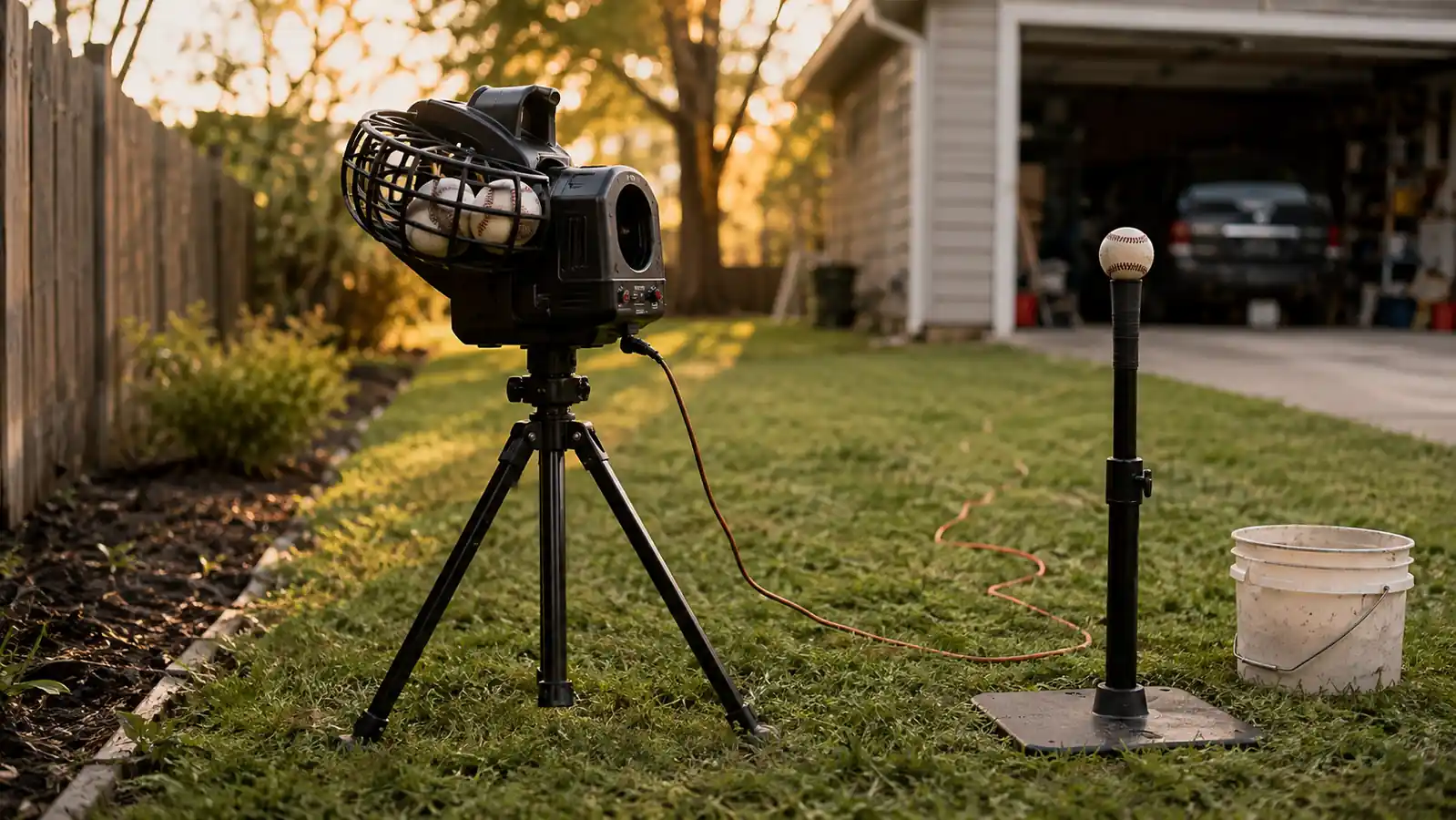
I bought the Louisville Slugger Blue Flame the first week of April, mostly because my son Eli was about to turn 11 and had just made the jump to a travel team where the pitching got noticeably faster than what he'd seen in house league. He plays second base and hits from the left side, and he needed more live reps than I could throw him with my arm holding up after a long work week. I set the Blue Flame up in the side yard between our garage and the fence line, ran an extension cord out from the garage outlet, and pointed it at a portable net with a tarp backstop I already owned from his tee-ball years. Five months and something close to 40 sessions later, spread across April through the end of August, I have a pretty clear read on what this machine does well and where it starts to show its limits.
This isn't a review from one afternoon of unboxing and a dozen pitches. Eli and I used this machine two to three times a week most weeks, sometimes more when a tournament was coming up, and I ran my own cuts through it occasionally on weekends when I wanted reps before my Sunday rec league games. That's the use case this review covers: real, repeated backyard batting practice, not a single demo session.
The Quick Verdict
A genuinely useful backyard BP tool for the price, with speed consistency that held up all season, but the setup and takedown routine gets old faster than the pitching does.
Amazon Check Today's Price →Stop burning out your arm throwing BP your kid has already outgrown.
If you're still soft-tossing to a hitter who's facing 55 mph pitching on weekends, a machine that throws the same strike over and over closes that gap fast. Check today's price and current stock on Amazon.
Amazon Check Today's Price on Amazon →How I've Used It
The Louisville Slugger Blue Flame is light enough that I carry the whole unit, tripod attached, out to the yard in one trip. It's somewhere in the mid-20-pound range fully assembled, which matters more than it sounds like it should when you're the one hauling it out and back in twice a week for five months. The tripod legs have adjustable feet for uneven ground, which our side yard definitely has thanks to a low spot near the fence, and I never had the machine tip or walk on me during a session once the legs were locked and the feet were set.
Per the manual, it's built to throw both real baseballs and the lightweight poly balls that come in the box, and I used both depending on the session. Real balls off a metal barrel come back out of the yard fast and sometimes into the neighbor's grass, so a lot of our early sessions used the poly balls until I got the net positioning dialed in and stopped losing balls over the fence. Once I moved the whole setup about eight feet closer to the garage and angled it slightly, that problem mostly went away and we shifted to real baseballs for most of the summer, since Eli said the poly balls behaved differently off the bat than what he sees in games.
The speed dial runs from a slow toss speed up into the mid-50s, and we spent most of our time somewhere in the high 30s to mid 40s for Eli, bumping it up as the season went on and he adjusted. I ran it closer to 50 for my own cuts on the handful of weekends I used it myself. Dialing in a specific speed took a little trial and error each session since the dial doesn't have hard numbered stops, just a sweep with rough markings, so if you want the exact same speed every single time you'll want to mark your own reference point with a piece of tape.

Setup Time and the Routine That Actually Stuck
The first few sessions took close to fifteen minutes between hauling the machine out, running the cord, setting up the net and tarp backstop, and finding a speed that felt right. By June that whole routine was down to about six or seven minutes, mostly because I'd already found the right spot in the yard and stopped experimenting with placement. That's the honest tradeoff with any pitching machine versus just tossing a ball by hand: even at its fastest, setup and teardown adds real time that a bucket and your own arm doesn't need.
Where the routine broke down was on days we only had twenty minutes before dinner or a practice. On those nights, the setup time ate a third of the session, and I'll admit there were a handful of evenings where I just threw batting practice by hand instead of bothering with the machine, purely because of the time cost. If your backyard sessions tend to be short and spontaneous rather than planned blocks of 30-plus minutes, factor that setup tax into whether this is the right tool for your routine. I also learned to check the sky before committing to setup, since running an extension cord across wet grass isn't something I want to deal with twice, and one August thunderstorm rolled in halfway through a session and forced a quick unplug-and-run that could have waited if I'd just checked the radar first.
What Five Months of Real Baseballs Did to the Feed Wheel
The feed wheel is the part I watched closest, since that's the mechanism doing the actual work every single pitch, and it's the part I'd expect to wear first on any machine in this price range. After roughly 40 sessions and what I'd estimate is somewhere north of 2,000 total pitches between Eli's reps and mine, the wheel still grips and releases the ball the same way it did in April. I didn't notice any slippage or inconsistent releases creeping in as the weeks went on, which is the failure mode I was most worried about given how many real leather baseballs we ran through it instead of sticking to the lighter poly balls.
Speed consistency held up the same way. I didn't track every single pitch with a radar gun, but I did spot-check with a cheap radar unit I already owned a handful of times across the season, once in April and again in August at the same dial setting, and the readings landed within two or three mph of each other both times. For backyard BP, that's plenty tight. It's not going to match a $2,000 machine used at a college practice facility, but it's consistent enough that Eli could actually groove his timing against it rather than fighting an unpredictable pitch every third or fourth throw.
Where I did see wear was cosmetic and mechanical in small ways: a bit of scuffing on the housing from being carried in and out of the garage so many times, and the tripod's height-adjustment knob got slightly harder to turn by midsummer, likely from grass and dirt working into the threads. A quick wipe-down and a drop of household oil on the knob fixed that in about two minutes, and it hasn't stuck since.

Real Baseballs vs the Poly Balls It Ships With
I mentioned this above but it's worth its own section because it changed our whole routine. The poly balls that come in the box are lighter and travel a bit differently off the bat, both slightly less pop and a different sound on contact, which Eli picked up on within his first few swings. He preferred real baseballs for anything that mattered, meaning any session in the two weeks before a tournament, and reserved the poly balls for early-season rust-shaking sessions when getting a ball back from behind the fence wasn't worth the walk.
The tradeoff is that real baseballs travel farther and harder off contact, which means your net and backstop setup needs to actually be able to handle full-speed line drives coming back at the machine and past it. Our tarp backstop held up fine, but I did have to replace one grommet that tore partway through the season from repeated impact. If you're going to run real baseballs through this consistently, budget for a sturdier net setup than whatever you might already have lying around from tee-ball days.
Noise Level and Working Around the Neighbors
One thing nobody mentioned to me before I bought this is how much the motor hums while it's running between pitches, sitting there waiting for the next ball to feed through. It's not loud enough to need earplugs, but it's a steady mechanical whir that carries across a quiet side yard, and our neighbor two houses down asked about it the first week purely out of curiosity, not complaint. By the second week nobody seemed to notice it anymore, and it never became an issue over the full five months, but if you live somewhere with close-set houses or strict quiet hours, it's worth running one test session at your actual practice time before committing to a regular weeknight schedule.
I also learned to keep sessions before 7 on weeknights once the days got shorter in August, both for the neighbors and because the ball gets hard to pick up out of the machine in low light well before it's actually dark outside. That's not a knock on the machine specifically, just a real scheduling constraint that came up more often than I expected once the school year started back up and our evening window shrank.

Alternatives I Looked At Before Buying
Before landing on the Louisville Slugger Blue Flame, I looked at a couple of higher-end machines a travel-ball dad on Eli's team owns, one of which is a heavier, three-wheel model built for higher and more varied pitch speeds with breaking-ball settings. His machine is genuinely more capable, but it's also nearly double the current price of the Blue Flame and weighs enough that he basically leaves it in his garage permanently rather than hauling it to a backyard. For our purposes, a lighter, single-speed-dial machine that I can carry in one trip and set up in under ten minutes made more sense than a machine with capabilities we weren't going to use every single session.
What I Liked
- Speed stayed consistent within two to three mph across a full five-month season
- Light enough to carry fully assembled in one trip, no separate hauling of parts
- Feed wheel showed no slippage after an estimated 2,000-plus pitches
- Handles both real baseballs and the included poly balls without issue
- Tripod height adjustment survived regular outdoor use with minor maintenance
Where It Falls Short
- Speed dial has no hard numbered stops, so repeating an exact speed takes your own marking
- Setup and teardown, six to seven minutes once dialed in, adds real time to short sessions
- Real baseballs travel far enough off contact that a flimsy net or backstop won't hold up
- Motor hum is noticeable enough to matter in a quiet neighborhood or during evening hours
- Not built for the higher-end pitch variety a serious travel program might eventually need
By June the setup routine was down to seven minutes. The wheel never slipped once, even after we stopped babying it with the light poly balls.
Who This Is For
This machine makes the most sense for a parent or adult rec player who wants consistent, repeatable BP in a backyard or driveway setup without hauling gear to a cage every time. If your kid is somewhere between house league and serious travel ball, the speed range covers most of what they'll actually see in games, and the light weight means you'll genuinely use it two or three times a week instead of letting it collect dust in the garage because it's a pain to set up. It's also a solid option for an adult player like me who just wants extra swings before weekend games without needing a second person to throw.
Who Should Skip It
If you're coaching a high-level travel or high school program and need breaking balls, a wider speed ceiling, or the durability to run hundreds of pitches a day across a full roster, this isn't built for that volume or variety, and the three-wheel machines built for programs will serve you better despite the extra cost and weight. I'd also skip it if your practice space genuinely can't fit a net and backstop capable of stopping a full-speed line drive, since that's less about the machine and more about not having anywhere safe to run it.
Five months in, this is still the machine I drag out on a Tuesday night without thinking twice.
If you're ready to trade sore-arm soft toss for reps your hitter can actually groove their timing against, check today's price and current availability on Amazon.
Amazon Check Today's Price on Amazon →