
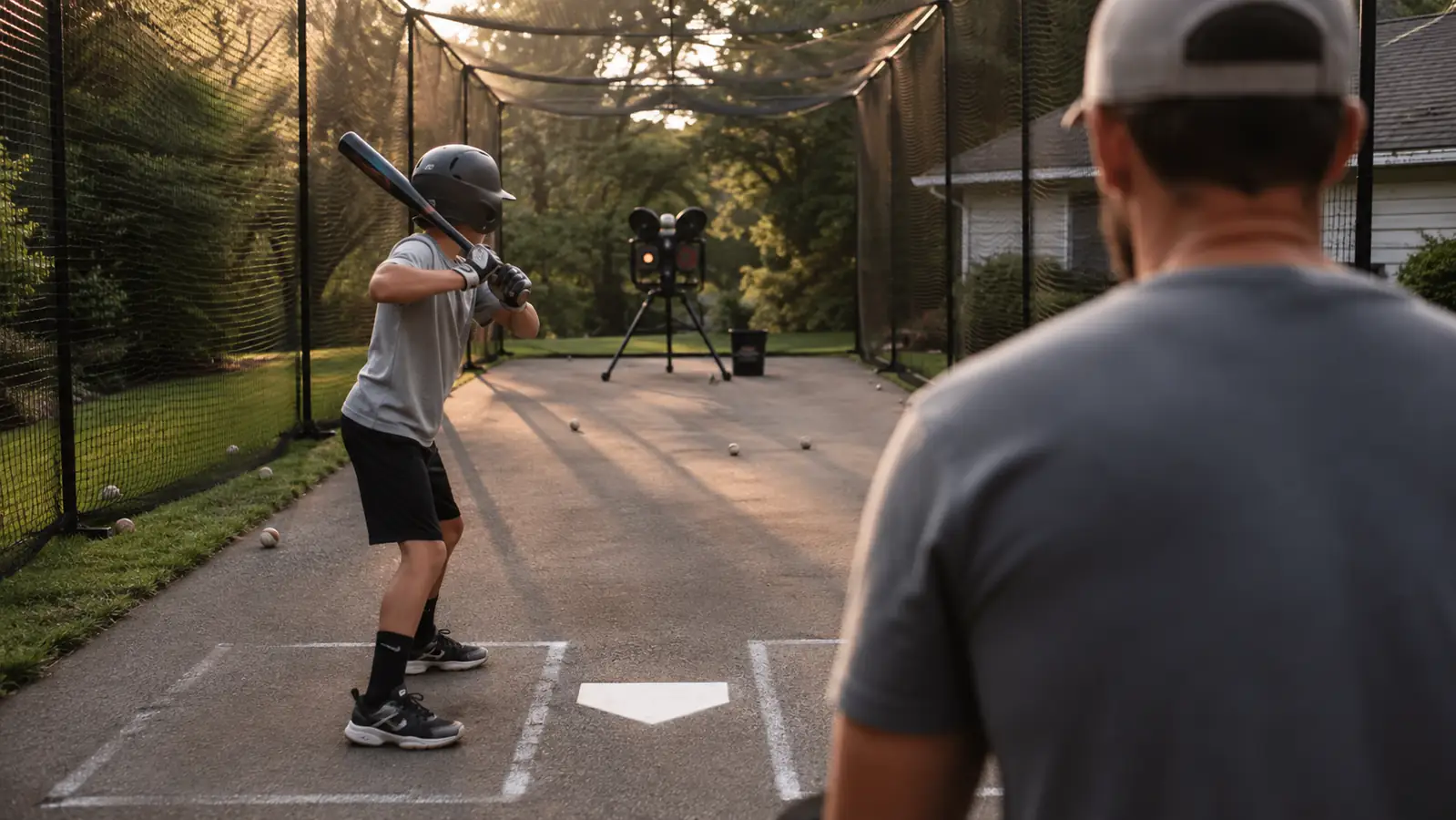
My son Eli is 11 and plays travel ball, and for two summers our Sunday routine was me lobbing balls off a five-gallon bucket in the driveway until my shoulder gave out around pitch forty. I ended up owning both machines in this comparison, the Louisville Slugger Blue Flame and the Franklin Power Pitcher, because I bought the Franklin first, wasn't happy with it by the end of that season, and replaced it with the Blue Flame the following spring. If you want the short answer before the details: the Blue Flame throws a more consistent pitch and holds up better over a full season outdoors, but the Franklin is lighter, costs less at today's price, and is perfectly fine for a kid who's just starting to track a moving ball instead of a ball on a tee.
Both machines are the same basic idea. A single wheel spins up and flings a ball at you, no arm or throwing mechanism, which is what keeps them light enough for one parent to carry to the yard and set up in under ten minutes. Neither one throws a curveball or a real changeup. Where they split is in how they hold that speed and shape over dozens of pitches, what they'll accept as a ball, and how long the housing survives a summer of being dragged in and out of a garage.
I want to be upfront that I'm not a coach and I don't get paid by either brand. I'm a rec-league dad who plays in a men's league on Wednesday nights and has two kids in travel ball, which means I've fed a lot of balls through both of these machines out of pure necessity, not curiosity. That's the lens for everything below.
| Blue Flame Pitching Machine | Franklin Power Pitcher | |
|---|---|---|
| Price | Around $149 at today's price | Around $110 at today's price |
| Speed Range | 15 to 45 mph, one-wheel design | 10 to 45 mph, dial-adjustable |
| Weight & Portability | About 16 lbs, tripod legs fold flat for the trunk | About 11 lbs, breaks down smaller for a bag |
| Power Source | Plugs into a standard outlet, no battery needed | Plugs into an outlet only, cord placement limits where you can set it up |
| Ball Compatibility | Real baseballs, softballs, and lightweight practice balls | Regulation baseballs only, no softball version offered |
| Pitch Consistency | Same release point pitch after pitch once dialed in | Wheel tension drifts after 30 to 40 pitches, needs re-tightening |
| Build Durability | Metal frame held up over two full seasons outdoors | Plastic housing cracked at the base mount after one summer |
| Warranty | 1-year manufacturer warranty | 90-day manufacturer warranty |
Where the Blue Flame Wins
The single biggest difference I noticed after the first two weeks was consistency. Once I got the Louisville Slugger Blue Flame's wheel angle and speed dial set for Eli's age group, roughly 42 mph with a slight rise, it threw that same pitch over and over. Out of a bucket of 20 balls I could count on maybe two that drifted off the plate, usually because the ball itself was scuffed or slightly out of round, not because the machine changed anything. The Franklin never gave me that. By ball 25 or 30 in a session, the wheel tension had loosened just enough that pitches started sailing high, and I'd have to stop mid-session and retighten the housing screw to bring it back.
The other real edge is what it will throw. The Blue Flame takes real baseballs and real softballs, which matters in our house because Eli's twin sister plays fastpitch and we use the same machine for both of them just by swapping balls and adjusting the speed down. The Franklin is baseball only. If you've got kids in both sports, or you coach a rec team that fields both, that alone is worth the price gap. The metal frame has also just held up better physically. It's spent two summers getting rained on before I remembered to bring it in, and it's still square. The Franklin's plastic base mount hairline-cracked by August of its first season, right where the tripod leg locks in.
It also throws a little more elevation range at the top end than I expected. I can angle the wheel to send pitches in on a slight downward plane, which is closer to what a taller travel-league pitcher's release looks like, instead of the flatter, almost line-drive angle you get from most backyard machines at this price. That's a small thing, but it's the difference between BP that looks like a real at-bat and BP that just teaches a kid to golf everything up in the air.

Where the Franklin Power Pitcher Wins
I'm not going to pretend the Franklin is a bad machine, because it isn't, and it earns its spot on this list honestly. It's lighter, easier for one person to carry fully assembled from the garage to the yard, and it breaks down into a smaller footprint if you're storing it in a closet instead of a garage. For a family without a lot of storage space, that's a real advantage, not a marketing line.
The bigger win is the low end of the speed dial. The Franklin goes down to 10 mph, which is genuinely slow, slow enough for a seven or eight-year-old just learning to track a pitched ball instead of a coach-pitched one. The Blue Flame's floor of 15 mph doesn't sound like much of a gap on paper, but for a kid that age it's the difference between making contact and bailing out of the box. If your primary use case is a younger sibling learning the basics rather than a travel player working on timing, the Franklin's lower range and lower price at today's rate make more sense than paying more for speeds you won't use for another two or three years.
Tired of re-tightening a wheel mid-session? See today's price on the Blue Flame.
The Louisville Slugger Blue Flame held its pitch consistency across two full outdoor seasons in our driveway. If steady, repeatable BP matters more to you than saving thirty dollars up front, this is the one to check.
Amazon Check Today's Price on Amazon →
What Made Me Switch After One Season With the Franklin
I want to be specific about this because 'it broke' isn't useful on its own. The Franklin's tripod mount is a molded plastic collar that the metal leg slides into and locks with a spring pin. By the end of that first summer, roughly 40 sessions, the collar had worn just enough that the leg would occasionally slip a half inch under the machine's own vibration, which shifted the whole throwing angle mid-session without warning. It wasn't dangerous, but it meant I had to babysit the machine instead of just feeding balls, and Eli would ask why every third pitch was suddenly high.
That's the failure mode that pushed me to the Louisville Slugger Blue Flame. It wasn't that the Franklin threw badly on day one, it threw fine on day one, better than fine for the price. It's that a plastic-and-spring-pin mount doesn't survive a real season of outdoor use the way a metal frame does, and once that mount loosens, every other spec on the sheet stops mattering because you can't trust the pitch anymore.
How I Set Up Both Machines in the Same Driveway
I ran a direct back-to-back test one Saturday, partly because Eli asked which one was actually better and partly because I wanted to settle it for myself before writing any of this down. I set the Blue Flame up first at 40 feet, which is roughly the distance a coach-pitch or early travel lineup sees, leveled the tripod on the slight slope of our driveway, and dialed the speed to 40 mph. Setup took about eight minutes, most of which was finding a stable spot for the third tripod leg on the uneven concrete.
The Franklin went up in about six minutes, mostly because it's lighter and the legs lock faster. But once both were running, the difference showed up fast. I fed 15 balls through each machine while Eli just watched the pitches land instead of swinging, so nothing was skewed by his timing. The Blue Flame's pitches landed in roughly the same 12-inch box the whole way through. The Franklin started tight, then drifted higher and a little left over the last five balls, which tracked with the wheel tension loosening exactly the way it had all season.

The Ball Feed Problem Nobody Mentions
Neither machine auto-feeds. That surprises people who assume 'pitching machine' means you load a hopper and walk away. You don't. Someone stands next to the wheel and feeds one ball at a time, by hand, every three to five seconds depending on how fast you're going. That person is almost always going to be a parent, at least until the hitter is old enough to feed their own machine safely between swings, which I wouldn't trust before age 12 or so given how close your fingers get to a spinning wheel.
The feed motion itself felt safer on the Blue Flame, mostly because the feed slot sits slightly farther from the wheel housing and the machine has a small lip that guides the ball in without your fingers needing to get as close to the spin. The Franklin's feed slot is tighter, and a couple of times early on I caught myself getting closer to the wheel than I wanted to be, especially at the higher speed settings. If you'll have an older sibling or a less cautious adult feeding balls, that gap in feed clearance is worth factoring in, because it's the one safety difference between these two machines that the spec sheets never mention.
Maintenance is worth a quick mention too, since it's the part that decides whether either machine is still working in year two. The Blue Flame's wheel and motor housing are sealed well enough that I've never had to do more than wipe it down and store it somewhere dry, and I check the tripod bolts for tightness maybe once a month during the season. The Franklin needed more attention: wiping down the wheel tread to keep grip consistent, and checking that spring-pin mount before every single session once I knew it was wearing. Neither machine is complicated to maintain, but the Blue Flame is the one that's forgiving if you forget.
The machine that keeps its pitch the same on ball 40 as it did on ball one is the one that actually saves your Sunday, not the one that's fifteen dollars cheaper.
Who Should Buy Which
If you've got a player 10 and up who's working on timing against a consistent, repeatable pitch, or a house with both a baseball and a softball player, get the Blue Flame. The steadier wheel tension and real-ball compatibility across both sports make up the price difference within a season. For a rec-league team buying one machine to share at practice, the durability alone justifies it, because a shared machine gets far more use than one sitting in a single family's garage.
If your player is younger, just learning to track a moving ball for the first time, or you need something light enough to store in a closet and haul out for twenty minutes at a time, the Franklin's lower speed floor and smaller footprint are the more honest fit. There's no reason to pay more for speeds you won't touch for a couple more years, and if the plastic mount does eventually loosen, by then you'll likely know whether your kid is sticking with the sport enough to justify stepping up to the Blue Flame anyway.
Ready for backyard BP that doesn't need you on the mound?
Between the two, the Blue Flame is the one that's still running the same pitch after two seasons in our driveway. See today's price and current availability on Amazon.
Amazon Check Today's Price on Amazon →