
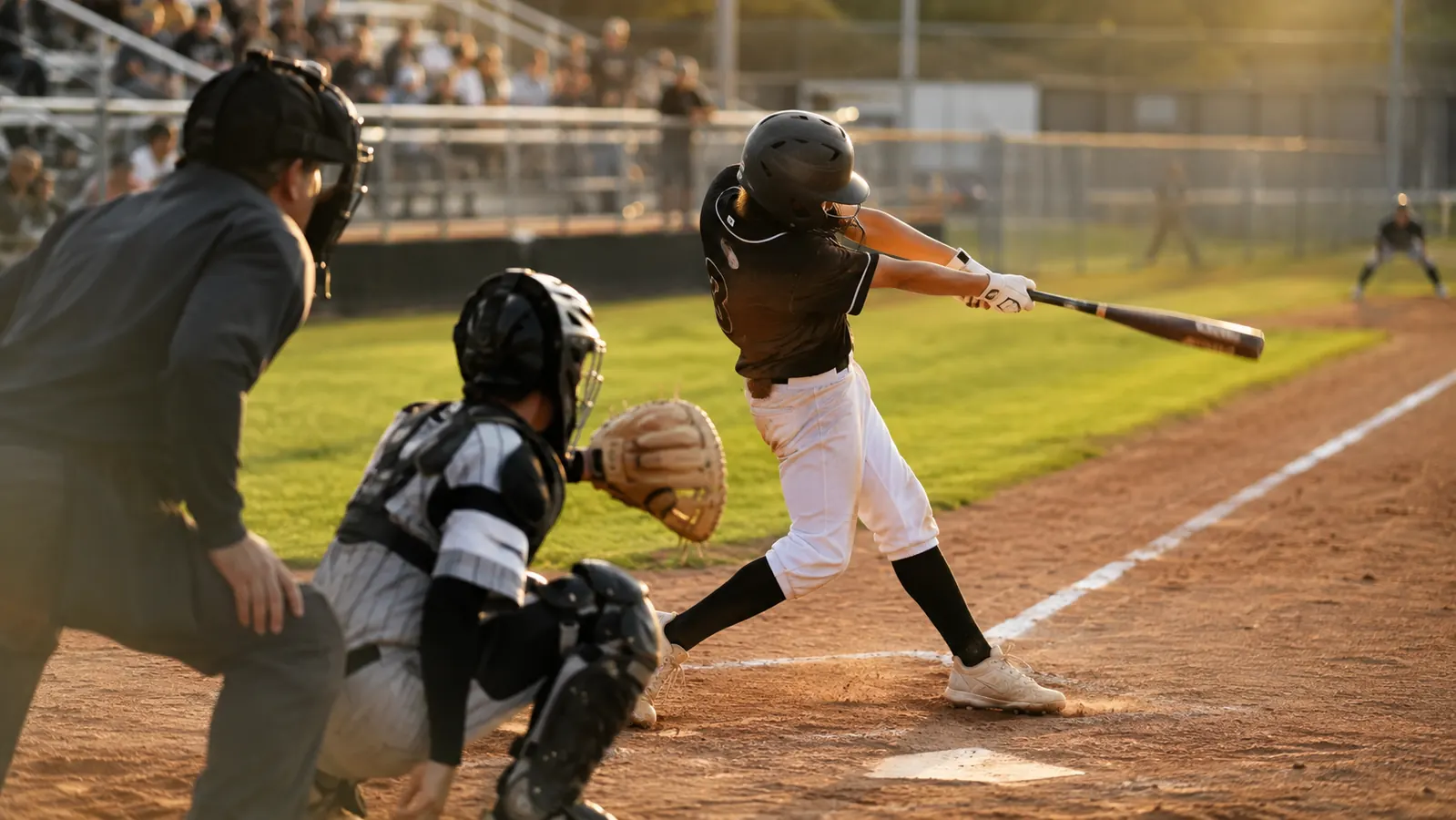
My son moved up to high school ball two summers ago and I made every mistake in the book buying his first BBCOR bat. I bought it a half inch too long because the salesman said "he'll grow into it," I ignored the drop weight entirely, and I didn't even check for the certification stamp until a tournament umpire flagged it during warmups. We swapped bats mid-tournament off a teammate's bag. Embarrassing, and completely avoidable.
BBCOR is the standard for high school and most college ball in the US: every legal bat is drop 3, meaning the length in inches minus the weight in ounces equals negative three, and every legal bat carries a small certification stamp near the barrel taper. That part is non-negotiable. Everything past that, length, swing weight, barrel material, feel, is where a $250 mistake happens if you skip the actual decision-making. After going through this twice now, once wrong and once right, here's the order I'd walk through it, using the bat we ended up on, the Louisville Slugger Meta, as the reference point since it's a well-rounded -3 that fits most of these decisions cleanly.
One more thing before the steps: buy this bat with the player in the room, not on your own while he's at practice. Every family I know that got the size wrong bought it as a surprise, ordered off a size chart with nobody actually holding a bat next to the kid. Fifteen minutes with a tape measure catches almost every mistake in this guide before money changes hands.
Skip the trial-and-error. Here's the bat that fit right the second time.
The Louisville Slugger Meta is a balanced, one-piece BBCOR bat that suits most high school swings without forcing you to guess on end-load or barrel stiffness first.
Amazon Check Today's Price on Amazon →Step 1: Nail down length before anything else
Length is the decision everyone rushes, and it's the one that costs you the most if you get it wrong, because a bat that's too long can't be fixed with tape or a different grip. The old sizing trick still works fine as a starting point: stand the bat upright with the knob resting on the ground and your arm hanging straight down at your side, and if the barrel end reaches roughly to the middle of your palm, that length is in range. For most players between 5'4" and 5'9", that lands on 31 or 32 inches. Taller, longer-armed kids move up to 33.
Don't buy a size up on the theory that he'll grow into it over the season. A bat that's too long drags the barrel through the zone late, and a late barrel on a 78 mph high school fastball is a swing-and-miss or a jam shot, not a growth opportunity. My son's first BBCOR bat was 33 inches when he should have been in a 32, and it took him most of a summer to figure out why he kept getting handcuffed on inside pitches. It wasn't his swing. It was an inch and a half of extra lever he couldn't control yet.
If he's between two lengths, size down. A shorter bat that gets to the zone on time beats a longer one that arrives late, every time, at every level below college power hitters who've built the bat speed to control the extra length.
Position matters here too, more than most families account for. A middle infielder who needs a fast, compact swing to catch up to a two-seamer running in on his hands is usually better off sizing down even from what the arm-length test suggests. A corner outfielder or first baseman with more time to see the pitch can lean toward the longer end of his range without the same tradeoff. If your son plays multiple positions, size for his most demanding at-bat, not his most comfortable one.

Step 2: Pick the drop weight, which for BBCOR just means picking the total weight
Since every legal BBCOR bat is drop 3, the only lever left is the total ounces, which is fixed once you pick a length. A 33 inch BBCOR bat weighs 30 ounces. A 31 inch weighs 28. There's no drop 8 or drop 10 shopping the way there is in youth USA bats, and that trips up a lot of parents coming from that world where drop weight was the headline spec on every product page.
What you're actually choosing at this stage is length, and the weight follows automatically. This is also why two BBCOR bats at the same length can still feel completely different in the hands even though they're the exact same ounces on paper. That difference is swing weight, which is about where the mass sits inside the barrel, and it's covered in step 4. Don't let a salesperson sell you on "lighter feel" as a separate spec from length at this stage. There isn't one yet.
One thing worth checking: some leagues cap bat weight for younger high school divisions, usually freshman ball played with shorter fences. Ask the coach before ordering if your son is a freshman moving up, because a legal varsity bat isn't automatically legal for every sub-varsity league.
The heavier feel of a 30 or 31 ounce bat compared to a 26 ounce USA drop 10 he might be coming from is a real adjustment, and it's worth a few weeks of dry swings in the garage or backyard before opening day rather than finding out the hard way in his first at-bat of the season. Some kids adjust in a couple of practices. Others need a full preseason to stop feeling late on everything.

Step 3: Confirm the BBCOR certification stamp before you buy, not after
This is the one that got me. Every legal high school and college bat has a small silkscreened stamp near where the barrel starts to taper, reading something close to "BBCOR Certified." No stamp, no game. It sounds obvious written out like this, but it's genuinely easy to miss when you're comparing five bats on a screen and none of the thumbnail photos zoom in that far.
Before you buy, pull up the actual product photos and look for that stamp specifically, not just a general "meets high school rules" line in the description copy. Third-party sellers occasionally list youth or USSSA bats under confusing titles that mention high school ball in the text without the bat actually being drop 3 or certified. If a listing doesn't show the stamp clearly in at least one photo, that's a reason to look elsewhere before it's a reason to assume.
The Meta's stamp sits right where you'd expect it, clearly visible in the barrel taper photos, which is a small thing but it's the exact thing an umpire will check during a pregame equipment inspection. Get this wrong and your kid is standing at the plate with a bat he can't legally use, in front of everyone.

Step 4: Match the swing weight to how he actually swings, not to what he wants to swing
This is the step most families skip entirely, and it's the one with the biggest feel difference on contact. Bats at the same length and weight can be balanced, meaning the mass is spread evenly, or end-loaded, meaning more mass sits out toward the barrel end. End-loaded bats generate more raw power on solid contact because there's more mass moving through the zone, but they're slower to get started and punish late reactions harder. Balanced bats are quicker through the zone and more forgiving on off-timing swings, at some cost to top-end pop.
A high school hitter who's still building bat speed, or who plays a defensive infield position and needs quick hands more than raw power, almost always does better with a balanced or slightly balanced bat. A bigger kid who's already strong through the hips and is having timing issues rather than bat-speed issues can handle more end-load. The Meta lands in the balanced-to-slightly-end-loaded range, which is why it fits most high school lineups rather than only the biggest kids on the team.
If you can, get hands on the actual bat before buying, or at least a same-model demo at a batting cage. A bat that reads great on paper can still feel wrong the second he takes a dry swing with it. If a return window exists, use it. Swing feel is the one spec you genuinely cannot judge from a listing.
Step 5: Know the break-in and care rules before the bat shows up
One-piece alloy bats like the Meta are game-ready out of the box, no break-in period, which is one reason I'd point a first-time BBCOR buyer toward alloy over a composite two-piece design. Composite bats need anywhere from 150 to 300 controlled swings to reach full pop, and skip that process and the bat performs worse than an alloy for the first month, not better, which surprises a lot of parents expecting composite to mean upgraded.
Either construction has one hard rule: never use it in temperatures below 60 degrees Fahrenheit. Cold aluminum and cold composite both get brittle, and a bat cracked or dented from cold-weather use in April is not covered under warranty, because that's written into every manufacturer's terms as user damage. If your season starts early in a cold climate, keep the bat in the dugout, not the bat bag left in a cold car overnight, and let it sit at room temperature before game time.
Check the warranty length before buying too. Louisville Slugger backs the Meta for a full year against manufacturer defects, which covers a cracked barrel from normal use but not a dent from a curb or a driveway mishit. Register the bat with the serial number the day it arrives so you're not digging for a receipt from eight months ago if you ever need to file a claim.
Storage matters more than people think too. A bat left leaning in a hot car trunk all summer, or jammed at the bottom of a bag under cleats and a helmet, takes damage that never shows up as a crack, just a slow loss of pop over a season or two. A basic bat sleeve and a spot in the closet, not the trunk, is a five dollar habit that protects a $140 to $300 purchase.
What Else Helps
A good bat solves a lot, but it doesn't solve everything. Batting gloves with real grip on both hands cut down on bat slip during a full swing far more than most kids expect, and a $15 pair of gloves saves more mishits some seasons than a bat upgrade does. Off-season, a tee and a bucket of balls for straight repetition swings, focused on hitting the same pitch location the same way a hundred times, does more for timing than anything you can buy. The bat gets him to the plate legal and comfortable. The reps get him hits.
A cheap radar-adjacent swing sensor or a mirror in the garage for a live front-view check on stride and hand path costs less than most travel-ball entry fees and shows up faster in his numbers than a bat swap ever will, once the bat itself is legal and fits him correctly. Fix the equipment first. Then fix the swing.
The bat that's too long doesn't feel wrong until the fastball is already past him. By then it's not a swing problem, it's an equipment problem, and it looks exactly the same from the dugout.
Length, weight, stamp, swing weight, break-in. One bat that checks all five without a guessing game.
The Louisville Slugger Meta is a legal, one-piece BBCOR bat ready to swing out of the box, balanced enough to fit most high school hitters rather than just the biggest kid on the roster.
Amazon Check Today's Price on Amazon →