
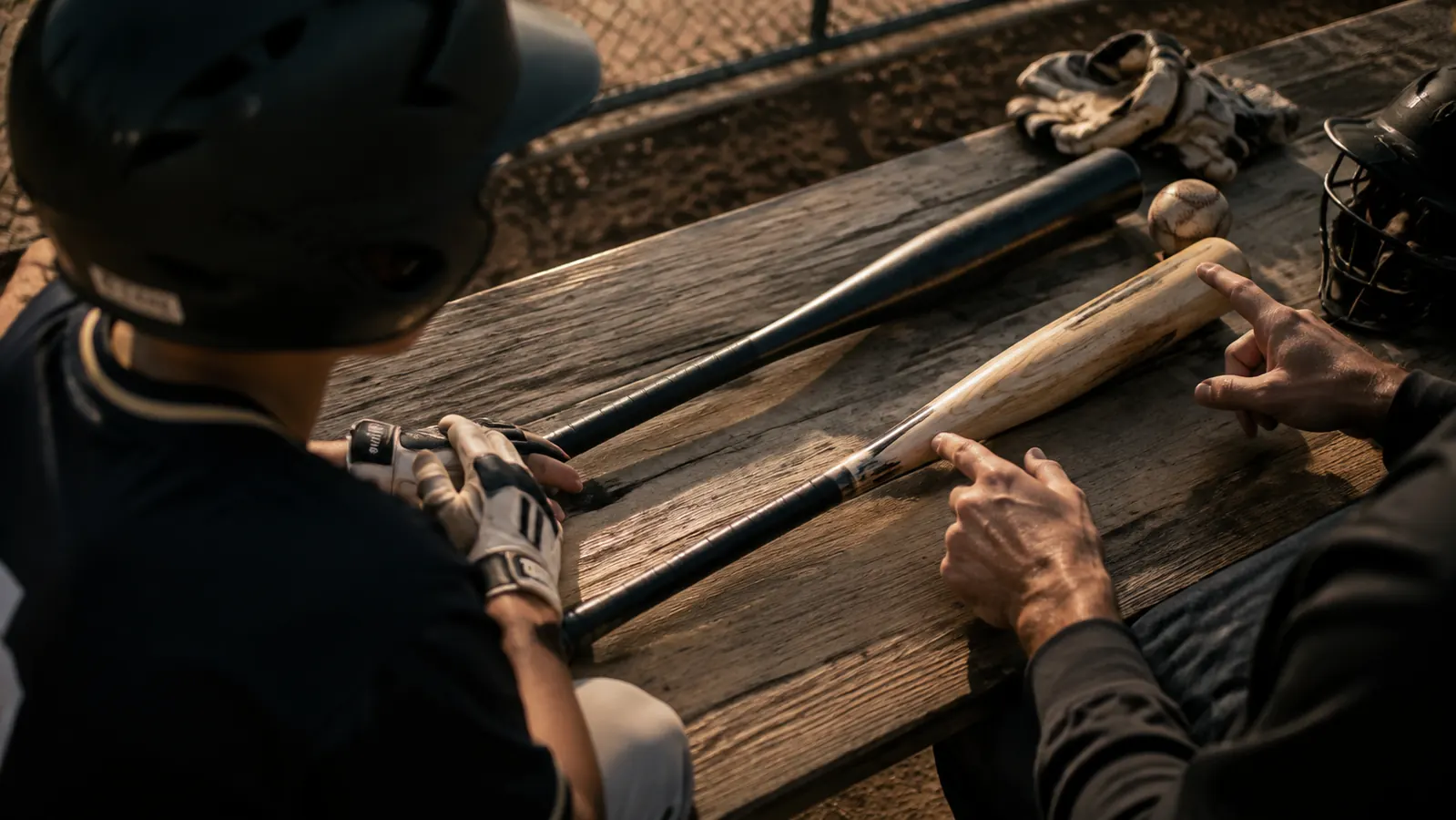
I've had a Louisville Slugger Meta and a Marucci CAT9 in the same bat bag for most of a season now, my son plays travel ball and half his teammates showed up with one or the other last spring, and I got tired of guessing which one was actually better based on a forum thread, so I bought both and let them fight it out in real at-bats. If you're trying to decide between the 2023 Louisville Slugger Meta (-3) BBCOR bat and the Marucci CAT9, here's the short version. The Meta swings like a bat that wants you to load up and drive the ball, with a full composite barrel that stays quiet on mishits and a break-in period that rewards a little patience. The CAT9 is a one-piece alloy bat that's ready the moment it comes out of the wrapper, balanced enough for a contact hitter to whip through the zone, and usually the cheaper buy of the two.
Neither bat is a bad choice, and I'd be lying if I said one of them dominates the other across the board. They're built around different ideas of what a good at-bat looks like. Below is the same spec-by-spec breakdown I made for myself before I let my son pick one to keep in his bag for the season, followed by the actual reasons each bat wins where it wins.
I tested both bats the same way over a full spring and summer season, not just a few cage swings at a sporting goods counter. We used the Meta in a 32-inch/29-ounce drop 3 and the CAT9 in the same length and drop so the comparison wasn't skewed by weight, and both bats saw live game at-bats, cage sessions, and soft toss over roughly four months. I logged which bat he used in which game, paid attention to exit sound and feel off the bat, and asked him after every game which one felt better that day rather than trusting my own eyes from behind the fence. That's the comparison below, not a spec sheet copied from a manufacturer's website.
Over that stretch he played in roughly 30 games between his rec league and a fall travel season, split close to evenly between the two bats once we started rotating them on purpose. I also had him use a cheap swing-speed sensor clipped to the knob for a few practice sessions just to see whether one bat let him generate more bat speed than the other, mostly out of curiosity rather than expecting a clear answer. The numbers were close enough that I wouldn't call either bat a speed advantage on paper. Where they actually separated was in how the ball came off the barrel and how his hands felt afterward, which a speed sensor doesn't measure at all.
| Louisville Slugger Meta | Marucci CAT9 | |
|---|---|---|
| Price (Typical Range) | Usually $130 to $150 | Usually $100 to $130 |
| Barrel Construction | One-piece full composite barrel (VCX Carbon) | One-piece AZ105 aluminum alloy barrel |
| Ready to Use | Needs roughly 150 to 200 swings to reach full pop | Full pop straight out of the wrapper, no break-in |
| Swing Weight | End-loaded, sits heavier through the zone for power hitters | Balanced, quicker through the zone for contact hitters |
| Sting on Mishits | Composite barrel dampens vibration well off the sweet spot | Alloy barrel transmits more sting on off-barrel contact |
| Cold-Weather Durability | Composite bats are more prone to cracking under about 60°F without a warm-up routine | Alloy handles cold early-season practice without extra care |
| Grip | Tacky factory grip that held up through a full season | Stock grip is fine but many players swap it out within a month |

Where the Louisville Slugger Meta Wins
The Meta's whole reason for existing is that VCX Carbon composite barrel, and once it's broken in, it's the better bat if you're a hitter who drives the ball rather than just makes contact with it. My son is a pull hitter who likes to get his hands through and turn on an inside pitch, and the Meta gives him a little more forgiveness when he's slightly under the ball than the CAT9 did. Composite construction just handles vibration differently than alloy. On a mishit low on the barrel or out toward the label, the Meta feels dead in a good way, no ring in your hands, where the CAT9 in the same spot buzzed enough that he shook his hand out between pitches a couple times early in the season.
The grip held up better too. We're eight months into using the Meta and the factory grip is still tacky enough that he doesn't wrap it in extra tape, while a buddy's CAT9 grip started getting slick around game 15 and he ended up replacing it with a Lizard Skins wrap. That's a small thing until you're standing in the box in July with sweaty hands and a bat that feels like it's going to slip on your backswing. The tradeoff for all of this is that the Meta doesn't feel like much of anything for the first few dozen swings. Composite barrels need break-in reps to activate the fibers, and if you hand a brand-new Meta to a kid for a game-day at-bat with zero practice swings first, he's going to wonder what the fuss is about.
Sound is the other thing nobody mentions until you've heard it in person. The Meta has a duller, lower-pitched crack that some parents in the stands actually complained sounded like a routine groundout even on balls that carried to the wall, which tells you something about how composite barrels are built to feel rather than announce themselves. Around midseason, once the barrel was fully broken in, he started pulling balls with legitimate carry to the gap that he hadn't been getting with his old drop 5 bat, and the length and end-loaded swing weight of the 32/29 Meta seemed to reward a full, committed swing rather than a short, defensive poke at the ball. If your kid already has some strength behind his swing, that end load is doing real work for him instead of fighting him.
On pure dollars, the Meta costs more up front, but if you're keeping the same bat for two full seasons rather than replacing it every year as your kid grows, the price gap narrows fast. A composite barrel that's still performing well after a full season and change is a better cost-per-game number than a cheaper bat you're nervous about trusting in year two. That's not true for every composite bat on the market, some crack or lose pop well before a year is up, but the Meta has held its performance for us longer than I expected going in, and I say that as someone who was skeptical of composite bats generally after a bad experience with a different brand a few years back.

Where the Marucci CAT9 Wins
The CAT9's biggest advantage is that it doesn't ask anything of you. Pull it out of the box, take a couple practice cuts, and it's already performing at whatever level it's going to perform at for the rest of its life. That matters a lot more than people give it credit for when a kid gets a new bat two days before a tournament and there's no time for 150 warm-up swings in the backyard. Alloy barrels are also just tougher against the kind of cold-weather abuse that early spring practice throws at a bat. We used the CAT9 for indoor cage work in February when it was too cold to trust the composite barrel outside, and it never gave us a moment of concern about cracking.
The balance point is the other real difference, and it's not just marketing language. The CAT9 is built to swing lighter through the zone relative to its listed weight, which suits a contact hitter or a younger, smaller player who needs bat speed more than raw mass behind the ball. My son's teammate is a leadoff-type hitter, shorter and quicker to the ball, and the CAT9 fits his swing better than the Meta did when he borrowed it for a week. And on price, the CAT9 usually runs cheaper than the Meta at any given retailer, which is a real consideration if you've got a kid who's still growing out of bats every year or two and you don't want to drop the extra money on the composite version every single time.
There's also a practical resale and hand-me-down angle with the CAT9 that's worth mentioning. Alloy bats hold their usable life better than composite when they get passed down to a younger sibling or sold on a local swap group at the end of a season, because there's no wondering whether hairline cracks are hiding inside a carbon barrel that took a foul tip off a chain-link fence. We sold last year's CAT9 to a neighbor whose daughter was moving up to BBCOR, and it still had plenty of pop left in it. That's a real cost consideration if you're outfitting more than one kid or if your player is between sizes and you know this bat has a year, maybe two, before it gets replaced anyway.
The lighter swing weight also showed up in a very specific, unglamorous way, two-strike at-bats. When my son fell behind in the count and needed to shorten up and just get the bat to the ball, the CAT9 was easier for him to control on a quick, defensive swing than the Meta's end-loaded feel. That's not a knock on the Meta, a heavier end load is doing exactly what it's designed to do on a full swing, but in a two-strike, protect-the-plate situation, the CAT9's balance gave him an easier time making late adjustments. If your player is still working on plate discipline and needs a bat that forgives a late decision, that's worth factoring in.
If you're the pull hitter who wants the barrel to do the work, start here.
The Louisville Slugger Meta is the one we kept in the bag once the break-in period was behind us. Check today's price and current stock on Amazon before you decide.
Amazon Check Today's Price on Amazon →
Who Should Buy Which
If your hitter drives the ball, plays enough that a break-in period isn't a problem, and you want the softest hands-feel possible on mishits, the Meta is the better bat. It's also the better call if you can afford the slightly higher price and you're not going to be doing serious cage work in cold weather without a warm-up routine first. If your hitter is more of a contact guy, needs a bat that performs immediately with no ramp-up time, plays year-round including cold early-season practices, or you're watching the budget because he's still growing, the CAT9 is the more practical pick and you won't be giving up much performance for it. Either way, both are legitimate BBCOR bats that a lot of good high school and travel programs trust, and you're not making a mistake with either one. You're just picking which tradeoff fits your kid's swing and your season.
One more thing to weigh that has nothing to do with barrel material: how often your player is actually swinging in practice between games. If he's taking cuts three or four times a week, the Meta's break-in period is a non-issue, it'll be fully activated before your first tournament even starts. If he's a one or two-practice-a-week kid because of school or other sports, the CAT9's zero break-in time means he's never showing up to a game with a bat that hasn't reached its potential yet. That's a scheduling question as much as a performance one, and it's the piece I underweighted the first time I made this decision.
Still leaning toward the Meta after reading all that?
See the current price, available lengths, and drop weight options for the Louisville Slugger Meta on Amazon.
Amazon Check Today's Price on Amazon →