
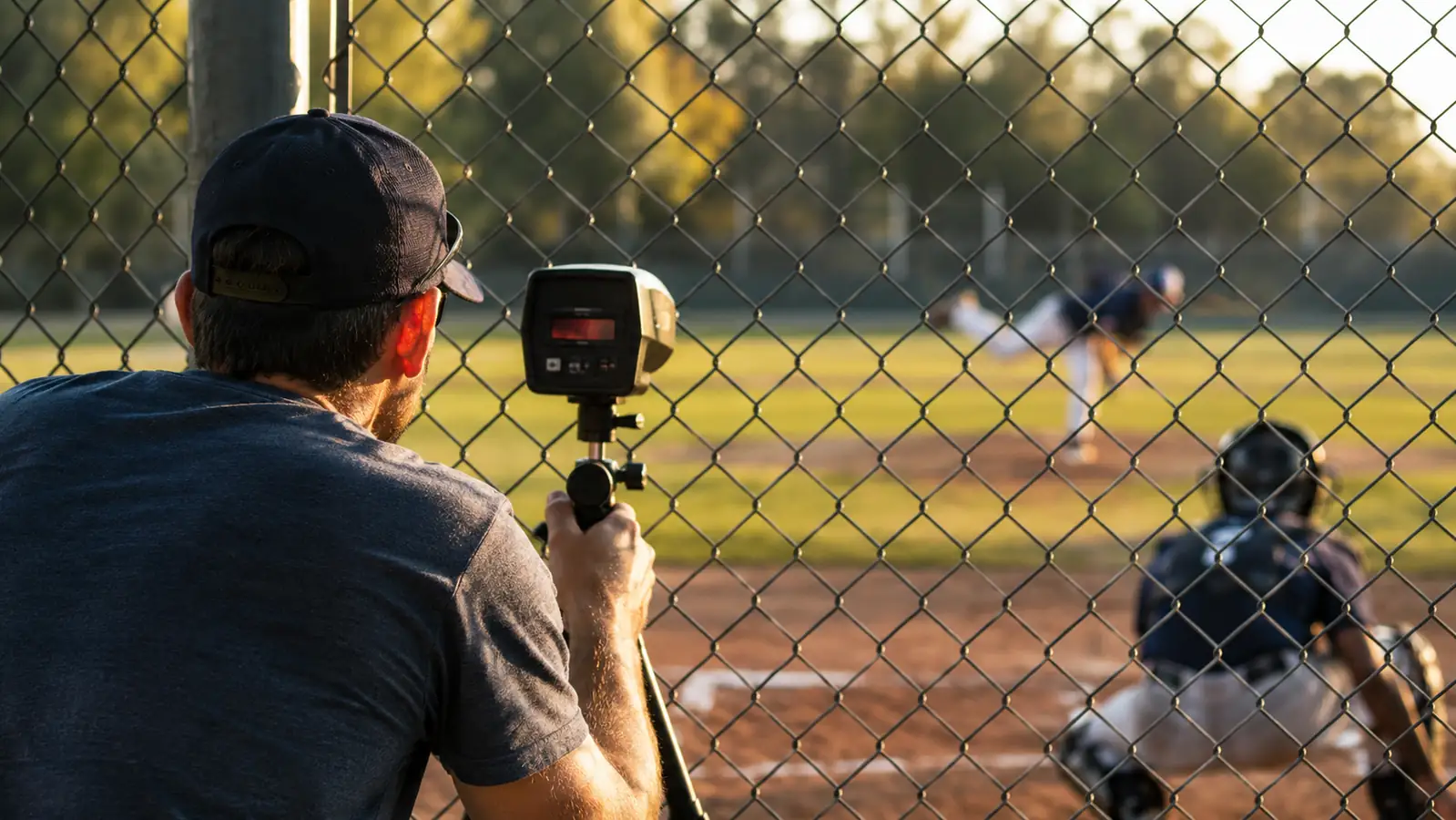
For two summers I tried to figure out whether my son's fastball was actually getting faster or whether I just wanted it to be. I'd stand behind the fence, watch him let one go that looked electric, and tell myself "that one had to be 68, maybe 70." Then the next week I'd watch the exact same delivery and think it looked slower. None of that was real data. It was a dad with a gut feeling, no reference point, and no way to check either guess.
A radar gun fixes that, but only if you use it the same way every time. Point it from a different angle, a different distance, or a different spot in the yard each session, and you'll get numbers that jump around for reasons that have nothing to do with how hard your kid actually threw. That's the trap most home setups fall into: they buy a gun expecting instant clarity, then get more confused than before because the numbers don't line up week to week. This guide walks through the setup we settled on with a Pocket Radar Smart Coach, gun placement, distance, the angle error nobody explains, and how to log readings so a month of numbers actually tells you something instead of just handing you a bigger pile of confusing readings.
Stop Guessing Whether He's Actually Throwing Harder
A stopwatch app and a hunch aren't data. The Pocket Radar Smart Coach gives you a real per-pitch reading and logs it straight to your phone, so six weeks from now you have an actual trend line instead of a memory of one pitch that looked good.
Amazon Check Today's Price on Amazon →Step 1: Pick one throwing distance and don't change it
Velocity readings need a fixed reference point or you're not comparing anything real. We use a painted rubber at 46 feet in the driveway for my younger son (he's 12), and moved him to the 54-foot mark the week he turned 13, matching the mound distance jump his league uses. My older son throws off an actual mound at 60 feet 6 inches whenever the field is open, and off a 50-foot flat-ground mark in the yard when it isn't.
The distance itself doesn't need to match a real mound exactly, but it needs to be the same distance every session for that player, because mechanics and effort change with distance. A kid who's rushing a short-distance throw will show a different number than the same kid taking a full, controlled delivery at game distance. Write the distance down next to every reading. If you ever change it, note the date, because that's the moment your trend line resets, and comparing anything before that date to anything after it is comparing two different tests.
If you've got a driveway or side yard instead of a field, mark both ends with spray chalk or even a strip of gaffer's tape. It takes thirty seconds and it means you're never eyeballing "about where I stood last time," which is exactly the kind of small drift that makes a perfectly good radar gun look inconsistent when the gun was never the problem.
If it's a softball pitcher in the house, the same rule applies with a different number. Fastpitch distance runs 40 to 43 feet depending on age and league, well short of the baseball mound, so don't borrow a baseball distance mark for a softball arm and expect the readings to mean anything next to each other. Pick the real league distance for that player's level and stay there.

Step 2: Get the gun placement and angle right, or the number is a lie
This is the part almost nobody explains, and it's the reason a lot of home radar readings run low for no obvious reason. A radar gun measures the speed of the ball moving directly toward it. If the gun isn't lined up on the exact path of the throw, it's only reading the piece of that speed pointing at the sensor, not the full velocity. That's called cosine error, and it's not a rounding error, it adds up fast.
Being roughly 10 degrees off the throwing line reads about 1.5 percent low. That sounds small until you're at 20 degrees off, which drops the reading closer to 6 percent low, enough to make a real 68 mph fastball read as a 64. Stand off to the side at an angle to "get a better view" of the pitcher's face or the catcher's mitt, and you will absolutely convince yourself velocity dropped when it didn't move at all.
The fix is simple: put the gun directly behind the pitcher, in line with home plate, not off to one side. The Pocket Radar Smart Coach is built to be held or tripod-mounted right behind the throwing lane, roughly chest to waist height, six to eight feet back from the rubber or mark. If you'd rather stand behind the catcher facing back out at the pitcher, that works too, same rule applies: stay square on the line the ball is actually traveling, not the angle that happens to be comfortable for you to stand at.
A cheap tripod helps more than it sounds like it would. Handheld, your arm drifts a degree or two over the course of a bullpen without you noticing, especially if you're also trying to film or coach in between throws. Locking the gun on a tripod at a fixed height, dead center on the throwing lane, removes that drift entirely and is the single easiest upgrade to a home setup.
Worth doing once, just to trust your own setup: have two people record the same pitch, one on the tripod dead center, one standing off at an angle, and compare the two numbers side by side. Seeing the off-angle reading come back a few miles an hour lower on the exact same throw makes the cosine error real in a way that reading about it never quite does.

Step 3: Log every throw the same way, not just the one you liked
It's tempting to only write down the pitch that flashed the biggest number and forget the rest of the bullpen. Don't. The Smart Coach app timestamps and saves every reading in a session automatically, so you get the full spread, not a highlight reel. That matters because a single peak throw tells you almost nothing about how a kid is actually developing.
For every session, we log four things: the date, the distance, the top velocity, and the session average across all fastballs thrown. The average is the number that actually moves over weeks. Peak velocity bounces around based on adrenaline, one great release, or a kid trying to impress whoever's standing behind the fence that day.
Also log how the arm felt going in, fresh, a little tired, coming off a start two days earlier. That context is what turns a number into information. A lower reading after back-to-back travel games isn't a step backward, it's a tired arm doing exactly what a tired arm should do, and without that note next to the number you'll misread a normal dip as a problem.
Once a week we pull the session data into a plain spreadsheet, date down one column, distance, top velocity, average velocity, and arm status across the rest. It sounds like overkill for a backyard bullpen, but it takes maybe five minutes and it's the difference between a folder of app screenshots and a record you can actually read a season out of.

Step 4: Build a real baseline before you draw any conclusions
One session tells you almost nothing. Weather, sleep, how much throwing happened at practice that day, even how warmed up the arm actually was before the first recorded pitch, all of it moves the number a couple miles an hour in either direction. We didn't trust any single reading until we had at least four to six sessions logged across three or four weeks.
Once you've got that baseline, you're not asking "was today's number good," you're asking "is the rolling average from the last month higher than the rolling average from the month before." That question is a lot more useful, and a lot less likely to send you into a spiral because one Tuesday bullpen looked flat compared to the Saturday before it.
Step 5: Review the trend monthly, ignore the day-to-day noise
Once a month, we sit down and look at the whole log, not the last session. Plotting it on a simple chart makes the pattern obvious in a way a list of numbers on a phone never does, you can actually see the slope instead of arguing with yourself about whether last Thursday's number "felt" like progress.
One thing I'd genuinely caution against: velocity is easy to obsess over once you can see the exact number on a screen, and that pull isn't always healthy for a young arm. I don't let my son max effort every single throw of a session just to chase a bigger reading, and I don't stack a "let's see how hard he can throw" session on top of an already full mound schedule during the week. Most leagues and travel programs publish age-based pitch count and rest guidelines, and no radar gun changes what those guidelines say. If a session is specifically about testing velocity, I treat it as the added stress it is and plan rest around it, the same way I would around an extra outing. I'm not a coach or a trainer here, just a rec-league parent who's watched two kids go through this, and this is meant as plain common sense, not a scare tactic.
What Else Helps
Velocity is one input, not the whole picture. Filming the delivery on a phone at the same angle you use the radar gun gives you something to look at alongside the number, so a velocity dip has context, maybe the stride shortened, maybe the arm slot dropped a little from fatigue. Basic shoulder and hip mobility work between sessions, and actual rest days where the arm does nothing, tend to move the trend line more over a season than any single bullpen ever will. A consistent warm-up before every recorded session also matters more than people think, a rushed five-throw warm-up and a full ten-minute long-toss progression won't produce comparable numbers even at the same distance and angle. The gun tells you what happened. It doesn't tell you why, and chasing the number without asking why is how a lot of well-meaning velocity programs go sideways.
It's also worth checking your home numbers against a stadium or scout gun whenever you get the chance, a showcase, a college camp, a tournament with a radar posted behind the plate. It's not about catching your setup being wrong, it's a sanity check every year or two so you know your driveway readings and the readings a coach sees are in the same neighborhood, not just internally consistent with each other.
The number only means something if you can trust that you measured it the exact same way you did last month.
Get a Number You Can Actually Trust Next Time
Fix the distance, fix the angle, log every throw the same way, and the readings finally mean something. The Pocket Radar Smart Coach is the tool we settled on for doing that from a driveway, a side yard, or an actual mound.
Amazon Check Today's Price on Amazon →