
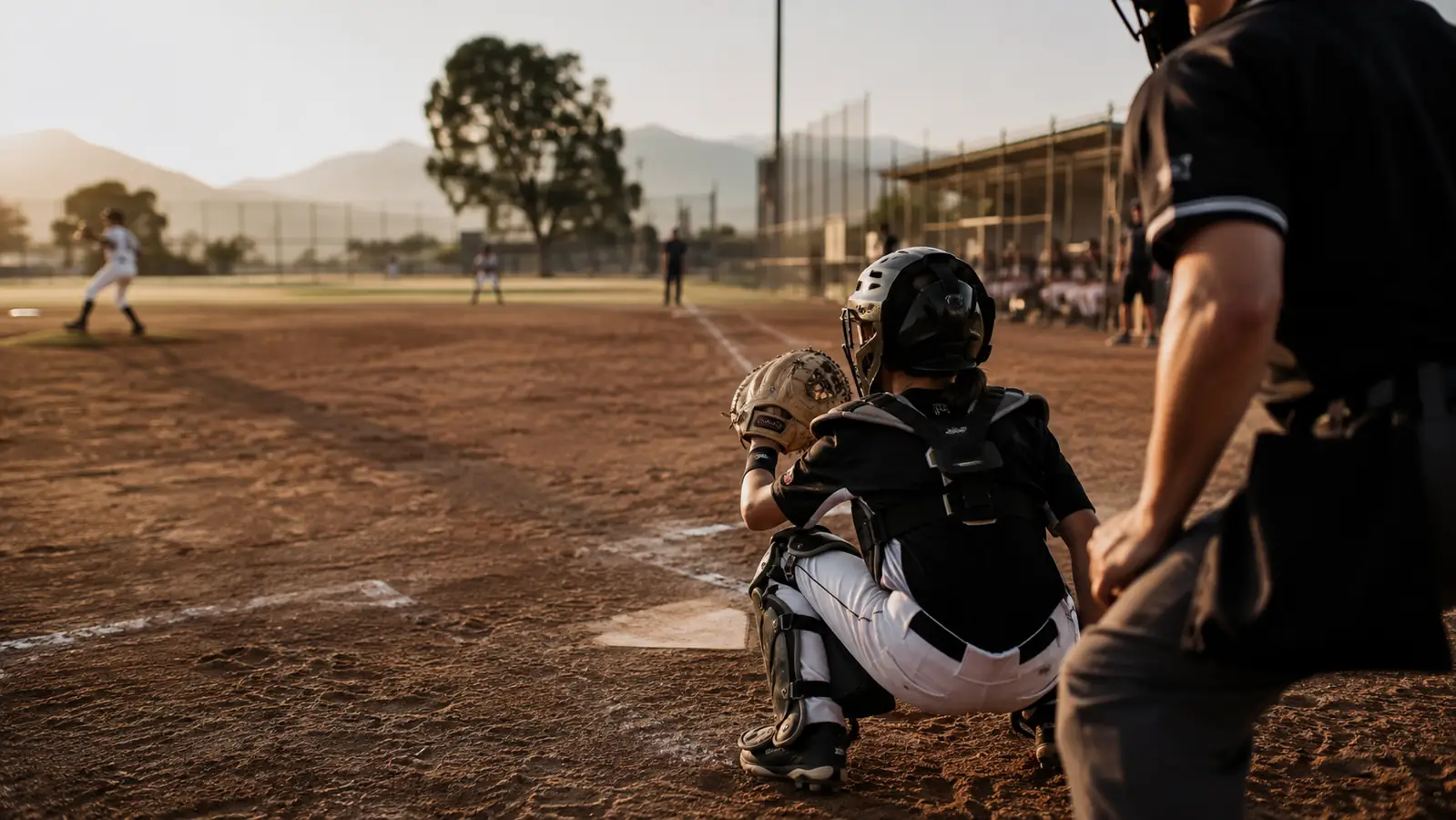
My son Deacon has caught every inning of every game for his 13U travel team since tryouts last February, which means for a solid stretch I was the parent driving to fields with a mitt bag rattling around the trunk and a garbage bag of gear that never matched. Chest protector from one closeout rack, leg guards handed down from a bigger kid two towns over, a helmet we picked up secondhand at a swap meet because the retail ones cost more than his bat. That patchwork setup is exactly what the Rawlings Velo 2.0 Catcher's Set was built to replace, and it's why we finally spent the money on one matched three-piece set instead of stitching something together every spring.
This isn't a quick unboxing. We bought the intermediate Velo 2.0 set in January, and by the time the summer all-star tournament wrapped in July, Deacon had worn it through 42 recorded games plus a couple dozen bullpen sessions and side work with our pitching staff. That's enough games for the padding to compress, the straps to get tested, and the seams to either hold or start fraying. Here's the honest read after all of it.
The Quick Verdict
A genuinely matched, well-built set for the price, with real tradeoffs in leg guard mobility and a helmet fit that runs snug for kids on the smaller end of the intermediate range.
Amazon Check Today's Price →Tired of gear that doesn't match and doesn't last a season?
The Velo 2.0 is a matched three-piece set built for exactly the problem most travel-ball families run into: patchwork gear that fits differently everywhere. See current sizing and today's price on Amazon.
Amazon Check Today's Price on Amazon →How I've Used It
Deacon is 13, about 5'5" and 135 pounds, which put him right in the middle of Rawlings' intermediate size chart when we ordered. We sized up from his old youth set based on that chart alone, no in-person try-on, since our nearest sporting goods store only stocks small and adult. The chart was accurate. The chest protector's harness had enough adjustment left on both the shoulder straps and the side buckles to fit him now and probably next spring too, based on how much slack is still in the webbing.
The set got real work starting in February with twice-a-week bullpen catching, then moved into a full spring league schedule, a summer travel slate, and that July all-star tournament, five games in three days in Georgia heat that pushed 95 degrees on the field. That tournament weekend is the closest thing I have to a stress test. He caught all five games back to back with no chance to fully air the padding out between them, and it's the stretch where I noticed the most padding compression and the first real signs of wear on the leg guard knee caps.
Outside of games, the gear lives in his equipment bag between the mask and his mitt, not in a locker or on a rack, which matters for how the padding held up. I mention that because a set that gets tossed in a bag crushed against other gear is a rougher life than one that airs out on a hook, and I want this review to reflect real use, not a display-case version of the product.

What We Used Before, and Why We Switched
Before the Velo 2.0, Deacon's setup was three separate purchases made over three separate years by three separate people. The chest protector came from a big-box clearance bin two seasons ago and was already a size too small when we got serious about travel ball. The leg guards were a hand-me-down from a teammate's older brother, a full size too big, held on with extra electrical tape wrapped around the ankle strap because the original Velcro had given out years before we ever owned them. The helmet was the only piece we bought new, but it was a basic entry-level model with a two-piece mask that fogged Deacon's view on cold mornings and didn't match the rest of the gear in color, weight, or fit.
None of those three pieces were designed to work together, and it showed every time he geared up. The chest protector rode up because the leg guards were bulky enough to change how he sat in his crouch, and the mismatched weight distribution meant he was more tired popping up to throw than he needed to be. Adding up what we'd spent on that patchwork over three years, replacing straps, buying a used chest protector, patching the leg guards, we were close to what one matched Velo 2.0 set cost us new, and we'd never once had all three pieces fit the same kid at the same time.
That's the real reason we switched, not because the old gear had catastrophically failed, but because we kept nickel-and-diming our way through mismatched pieces instead of buying one set that was designed to move together. If you're doing that same math with your own catcher's bag right now, it's worth actually adding up what you've spent piecemeal before deciding a matched set is the expensive option.
The Chest Protector: Coverage and Fit
The chest protector covers from just below the collarbone down past his belt line, with the wing panels extending out to cover the ribs on both sides when he's set in a crouch. The dual-density foam is noticeably firmer in the center chest panel than at the shoulder wings, which makes sense as a design choice, the wings are meant to flex when he shifts his weight to block a pitch in the dirt, while the center panel stays rigid.
Weight-wise, it's lighter than the hand-me-down set we replaced, which Deacon noticed in the first week and mentioned more than once without me asking. He said it was easier to pop up out of his crouch and get his throwing motion started, which lines up with what you'd expect from a lighter shell with less bulk under the arms.
The one fit issue worth flagging: the shoulder harness straps are adjustable but not infinitely so, and on a leaner kid they can bunch up under the armpit if you crank them too tight trying to keep the protector from riding up. We found the sweet spot by loosening the straps slightly and relying more on the side buckle tension, but it took a couple of games of trial and error to get there.

Leg Guards: Mobility Behind the Plate
The leg guards are where I have the most mixed feelings. Coverage is solid, they run from just above the knee down over the top of the foot, with a hinged knee cap and ankle rotation points that let Deacon get up out of his crouch without the guards catching on each other. On a full pop-time throw down to second, I didn't see the guards slow his transition compared to the old set.
Where they're heavier than I expected is in blocking. Rawlings uses a thicker foam at the shin than the youth-level sets we've owned before, and while that's a fair tradeoff for coverage, Deacon said early on that his legs felt more tired by the fourth or fifth inning of a doubleheader compared to his old lighter guards. That feeling faded some as the season went on and he built up to the added weight, but it's real and worth knowing before you buy, especially for a catcher who's still growing into his frame.
The Helmet and Mask: Visibility and Fit
The two-tone helmet uses a hockey-style cage rather than a traditional two-piece mask, which is what most of the other catchers in Deacon's league were wearing too. Visibility through the cage bars didn't seem to bother him tracking pitches or popping his mask off for a foul ball, and he's caught bullpens in direct afternoon sun without complaining about glare off the bars, which had been an issue with our old mask.
Fit is snug, more snug than I expected given how roomy the chest protector felt. Deacon wears it with the stock padding and a thin skull cap underneath on cold-weather games, and it fits well that way, but a kid on the smaller end of the intermediate range or one who prefers extra padding underneath might find it tight across the temples. We didn't need to swap or add any padding, but I'd size up if your player is borderline between youth and intermediate.

Durability After a Full Season
By the end of July, the chest protector's center panel foam had compressed slightly, noticeable if you press on it side by side with a brand-new one, but it hadn't cracked, split, or lost its shape. The stitching on the wing panels, which I watched closely because that's usually the first failure point on cheaper gear, showed zero fraying. The leg guard straps are the one component I'd call worn rather than just broken in, the Velcro on the back-of-calf strap has lost some grip and needs a firmer press to stay closed than it did in February.
The helmet held up the best of the three pieces. No cracks in the shell, no loosening in the cage hinges, and the chin strap padding is compressed but still doing its job. Given that this set absorbed 42 games of foul tips, bullpen sessions, and one brutal five-game weekend in Georgia heat, I'd call that a good showing for gear in this price range.
We hosed the leg guards and chest protector down after wet games a handful of times and let them air-dry on a rack in the garage rather than tossing them straight back in the bag damp. That's basic upkeep, not anything special to this set, but it's part of why the padding held its shape as well as it did. A season of games caught while damp gear gets sealed into a closed bag is a faster way to break down foam than anything the material itself does on its own.
What I Liked
- Matched three-piece set fits and moves together instead of three mismatched pieces fighting each other
- Chest protector is noticeably lighter than comparable hand-me-down and closeout gear
- Leg guard hinges allow a real pop-time transition, not a stiff shuffle
- Helmet cage held up to a full season of foul tips with no cracking
- Sizing chart matched our son's measurements accurately with no in-store fitting needed
Where It Falls Short
- Leg guard shin padding is heavier than youth-level sets, tiring on longer doubleheaders
- Helmet fits snug, borderline for smaller kids at the low end of the intermediate range
- Chest protector shoulder straps can bunch under the arm if over-tightened
- Leg guard calf strap Velcro loses some grip by mid-to-late season
It's the first set where all three pieces actually fit the same kid at the same time, instead of us patching together whatever was on sale that year.
Who This Is For
This set makes the most sense for a travel or competitive rec-league catcher who's already sized into the intermediate range, roughly 5'2" to 5'8" depending on build, and who's going to see enough game and bullpen reps to justify buying one matched set instead of cobbling pieces together. If you're the parent who's been buying a chest protector one year and leg guards the next because that's what was on sale, this closes that gap in one purchase, and the components are actually built to work as a set rather than three separate products bundled together at checkout. It's also a reasonable fit for a family weighing the real math on piecemeal replacement costs the way we were.
Who Should Skip It
A younger or smaller player still in true youth sizing should look at Rawlings' youth-specific set instead, this one will be loose in the wrong places even at the bottom of the intermediate chart. And a catcher who splits time at other positions and only straps on gear occasionally probably doesn't need to spend at this level, a basic entry set will cover a handful of innings a week just fine without asking you to pay for materials built to survive a full season of everyday use.
One season in, still the set we recommend to other catcher parents.
If your catcher is stuck rotating through mismatched hand-me-downs, check current sizing options and today's price on the Rawlings Velo 2.0 set on Amazon.
Amazon Check Today's Price on Amazon →