
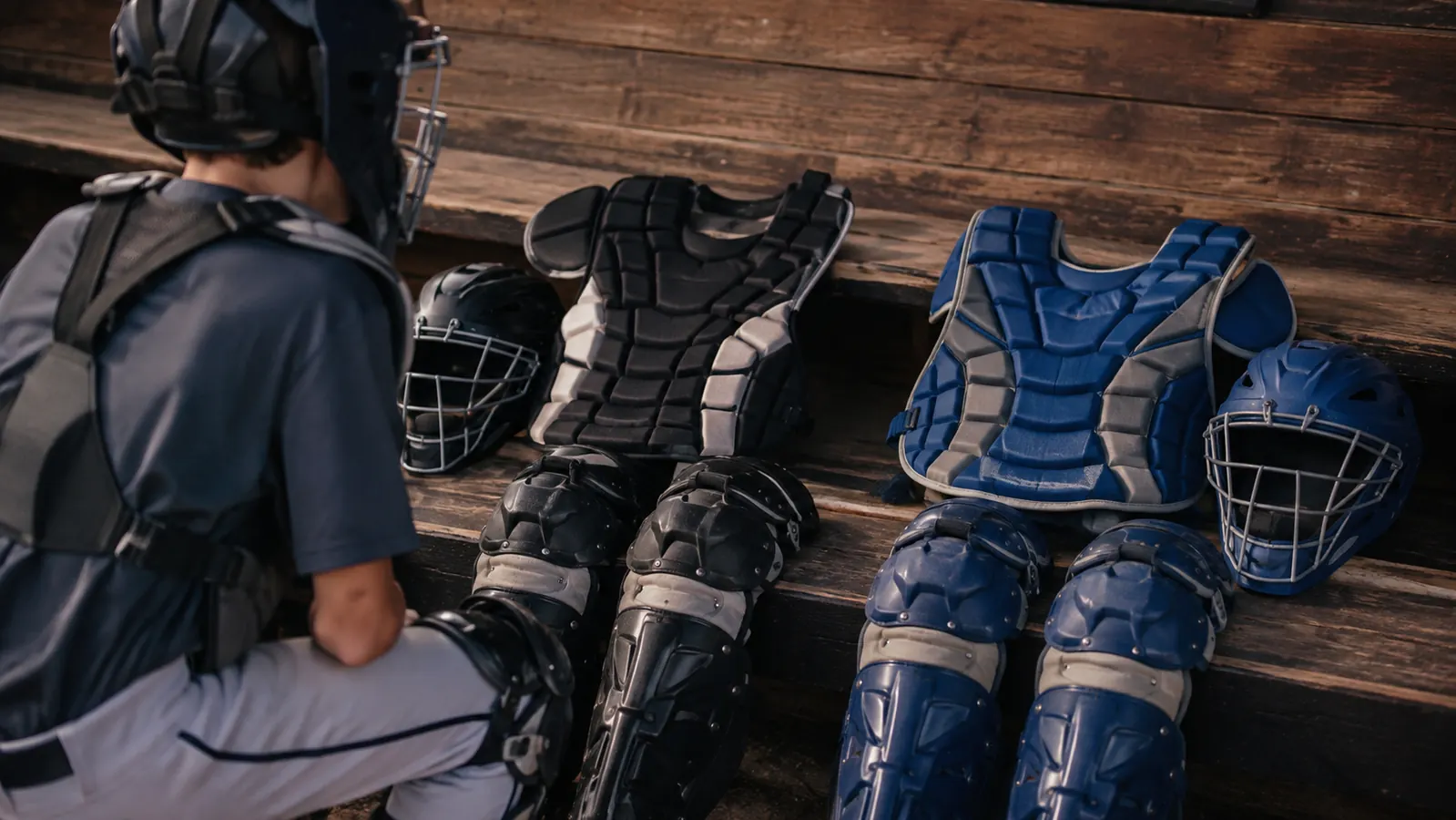
My son Deacon has caught for his 13U travel team for two full seasons now, and somewhere in between we ended up with both a Rawlings Velo 2.0 Catcher's Set and a teammate's All-Star Catcher's Kit sitting in our garage at the same time, because his backup catcher's parents were comparing notes with us before a tournament and we swapped gear for a weekend just to see the difference firsthand. If you're trying to decide between the two before buying a full matched set for your own catcher, here's the short version. The Rawlings Velo 2.0 is the lighter, more affordable set that fits a wider range of budgets and growing kids without sacrificing much real protection. The All-Star kit is heavier, pricier, and built with a bit more raw coverage and a better-ventilated mask, which is why you see more of it at the travel and high school level once a catcher stops growing every six months.
Neither set is the wrong pick. They're built around different priorities, weight and price versus coverage and ventilation, and which one wins depends more on your catcher's build, budget, and how many games a week he's actually strapping on gear for than on which brand name is stitched on the chest protector. Below is the spec-by-spec breakdown we put together after that gear swap, followed by the real reasons each set wins where it wins.
The swap wasn't just a five-minute try-on in the driveway. Deacon wore the borrowed All-Star kit for one full tournament weekend, five games in three days, while his teammate wore the Velo 2.0 for the same stretch, and we compared notes with the other family after every game. We weighed both full sets, piece by piece, on a bathroom scale before the weekend started, timed how long it took each kid to pop up out of the crouch on a handful of throw-downs, and checked in with both boys about fatigue, fogging, and fit at the end of each game rather than relying on how the gear looked from the stands. That's the comparison below, not two spec sheets pulled off a retailer page and set next to each other.
| Rawlings Velo 2.0 | All-Star Catcher's Kit | |
|---|---|---|
| Price (Typical Range) | Usually $270 to $320 for the full set | Usually $330 to $400 for the full set |
| Total Set Weight | Lighter shell and foam, easier to pop up out of the crouch | Noticeably heavier, especially in the leg guards |
| Chest Protector Coverage | Solid coverage from collarbone to belt with wing panels | Wider wing panels and higher-rebound foam, more coverage on angled foul tips |
| Mask and Cage | Painted steel cage, held up fine over a season of foul tips | Heavier-gauge steel cage, a common upgrade pick among travel-level catchers |
| Ventilation and Moisture Management | Standard mesh liner, gets damp on hot doubleheaders | Dedicated airflow channels in the chest protector and mask padding, dries faster between games |
| Sizing Range for Growing Players | Broad youth-to-intermediate range at a lower price point per size | Similar sizing tiers, but each size jump costs more |
| Color and Matching Options | More team-color combinations available at retail | Fewer color options, mostly black, navy, and scarlet |
| Replacement Parts Availability | Straps and pads available but limited to a few third-party sellers | Wider aftermarket support for straps, pads, and mask cages |

Where Rawlings Velo 2.0 Wins
The biggest thing the Velo 2.0 has going for it is that it doesn't punish you for buying a set built for a kid who's going to grow out of it in a year. Deacon was 5'5" when we bought his, and the price gap between the intermediate and adult versions was small enough that upgrading again next year won't feel like starting over from scratch financially. The All-Star kit's sizing tiers step up in price more sharply, which matters if you've got more than one catcher in the house or a kid who's still filling out. On top of that, the lighter overall build showed up the first week Deacon wore it. He noticed he could pop up and get his throwing motion started faster than he could in the borrowed All-Star set, which lines up with the weight difference we measured on a bathroom scale out of curiosity, the full Velo 2.0 set came in noticeably lighter piece for piece.
The color and matching options are a smaller point but a real one if your league or travel org has a specific team color. We were able to get the Velo 2.0 in a shade that matched Deacon's team navy closely enough that nobody asked why his gear didn't match, where the All-Star kit's color lineup is thinner and mostly leans toward a handful of standard combinations. And for a family that's buying gear out of pocket rather than through a team equipment budget, the lower price per size tier across the whole Velo 2.0 range adds up over a few years of replacements in a way that's easy to underweight when you're only looking at one purchase in isolation.
The leg guards deserve a specific mention too, because that's where the weight difference between the two sets was most obvious to Deacon himself. He said the Velo 2.0 leg guards felt noticeably easier on his legs by the fifth inning of a doubleheader than the borrowed All-Star pair did, and while that's one kid's subjective read rather than a lab measurement, it matched what we saw on the scale beforehand. If your catcher is going to be blocking pitches and popping up to throw down all game, every game, for a long tournament weekend, that lighter build adds up over dozens of reps in a way that's hard to notice in a single practice but obvious by game four.
Durability held up about the same across both sets over that one weekend, which isn't a long enough stretch to call a verdict on either one's full season life. But over the two years we've now owned our own Velo 2.0 set, the stitching on the wing panels hasn't frayed, the mask cage hasn't loosened at the hinges, and the straps still hold tension without needing replacement. That's a reasonable data point on its own, even without a matching multi-year track record for the borrowed All-Star kit to compare it against directly.

Where All-Star Catcher's Kit Wins
The All-Star kit earns its higher price mostly in two places, chest protector coverage and ventilation. The wing panels extend a bit further around the ribs, and the foam has more rebound to it, which showed up clearly on a handful of foul tips that caught Deacon at an angle during the weekend he wore the borrowed set, the kind of glancing hit where extra coverage at the edge actually matters. The mask cage is the heavier-gauge steel that a lot of travel and high school programs specifically ask for, and it's part of why you'll see more All-Star gear once a catcher is done growing and a family is buying for durability over multiple seasons rather than sizing up every year.
Ventilation is the other real difference, and it's not marketing language. The dedicated airflow channels in the chest protector and mask padding meant the borrowed set was noticeably drier by the end of a hot doubleheader than Deacon's own gear usually is, which matters more than people think when a catcher is wearing the same padding for five games in a weekend tournament. The tradeoff is weight and price, that extra foam and steel adds pounds that a smaller or younger catcher will feel by the fourth or fifth inning, and the aftermarket parts support, while wider than Rawlings', still means you're spending more overall to keep the set fresh over multiple seasons.
The hockey-style mask on the All-Star kit also sat slightly more open around the temples than the Velo 2.0's, according to Deacon, which he noticed mostly on hot afternoon games when he was already running warm under the chest protector. That's a small thing on paper, but for a catcher who's already dealing with a heavier overall set, a mask that breathes a little better around the head helps offset some of the extra weight elsewhere. It's the kind of tradeoff that only shows up when you've actually worn both sets back to back rather than reading a spec list.
There's also a hand-me-down angle worth noting on the All-Star side. Because the kit is built heavier and with tougher materials up front, a family that's done growing a catcher through it, or one whose son moved on to a different position, tends to get a better resale price passing it along to another travel family than they would with a lighter, more entry-level-leaning set. If you're the kind of household that plans to sell gear on a local swap group once your son ages out of it, that's a small but real factor in the total cost of ownership, not just the sticker price on day one.
Want the lighter, more affordable set that still holds up to a full season?
The Rawlings Velo 2.0 is the one we kept for everyday use once the comparison weekend was over. Check current sizing and today's price on Amazon.
Amazon Check Today's Price on Amazon →
Who Should Buy Which
If your catcher is still growing, you're watching the budget, or you want a matched set with a color that actually fits your team, the Rawlings Velo 2.0 is the more practical buy and you won't be giving up much real protection to get there. If your catcher has stopped growing, plays enough games in a weekend that ventilation actually matters, or you're at the travel or high school level where coverage and mask durability under repeated foul-tip contact are worth paying more for, the All-Star kit is the better long-term investment. Both are legitimate, widely used sets behind the plate at real programs, and the honest answer is that this comes down to your catcher's build and how many games a week he's strapping on gear for, not which brand name looks better in the team photo.
One more thing worth weighing that has nothing to do with foam density: how often your catcher is actually going to be in gear between now and the point where he outgrows it. A kid who catches once or twice a week in rec league is going to feel the Velo 2.0's lighter build as a straightforward win with no real downside, since he's rarely on the field long enough for the All-Star kit's extra coverage to matter. A kid catching four or five games a weekend at a competitive travel level is a different case, and that's where the heavier, better-ventilated All-Star kit starts to make more financial sense despite the higher sticker price, because the coverage and moisture management are doing real work across that much wear.
Still leaning toward the lighter, more affordable set?
See current sizing, color options, and today's price for the Rawlings Velo 2.0 Catcher's Set on Amazon.
Amazon Check Today's Price on Amazon →