My daughter caught her first full travel season at ten years old in a hand-me-down chest protector that was almost two sizes too long. It looked fine standing up. The second she dropped into a crouch, the bottom edge rode up past her belt and left a gap at her hips every single time. Nobody noticed until a foul tip found that exact gap in a June tournament. That's the sizing mistake almost every parent makes with catcher's gear, we size for the kid we think he's about to become instead of the one standing in front of us right now.
This guide walks through the actual measurements, sternum to navel for the chest protector, knee to ankle for the leg guards, real hat size for the helmet, hand size and position for the mitt, using the Rawlings Velo 2.0 Catcher's Set as the reference set because it's sold in clearly labeled size bands rather than vague 'youth/adult' guessing. Whatever brand you land on, the measuring process below is the same, and it takes about ten minutes with a soft tape measure from a sewing kit, nothing fancier than that.
Stop eyeballing it. Measure first, then buy.
The Rawlings Velo 2.0 Catcher's Set breaks its chest protector, leg guards, and helmet into matched size bands instead of one-size-fits-most. Check today's price on Amazon and have your tape measure numbers ready before you order.
Amazon Check Today's Price on Amazon →Step 1: Measure Sternum to Navel for the Chest Protector
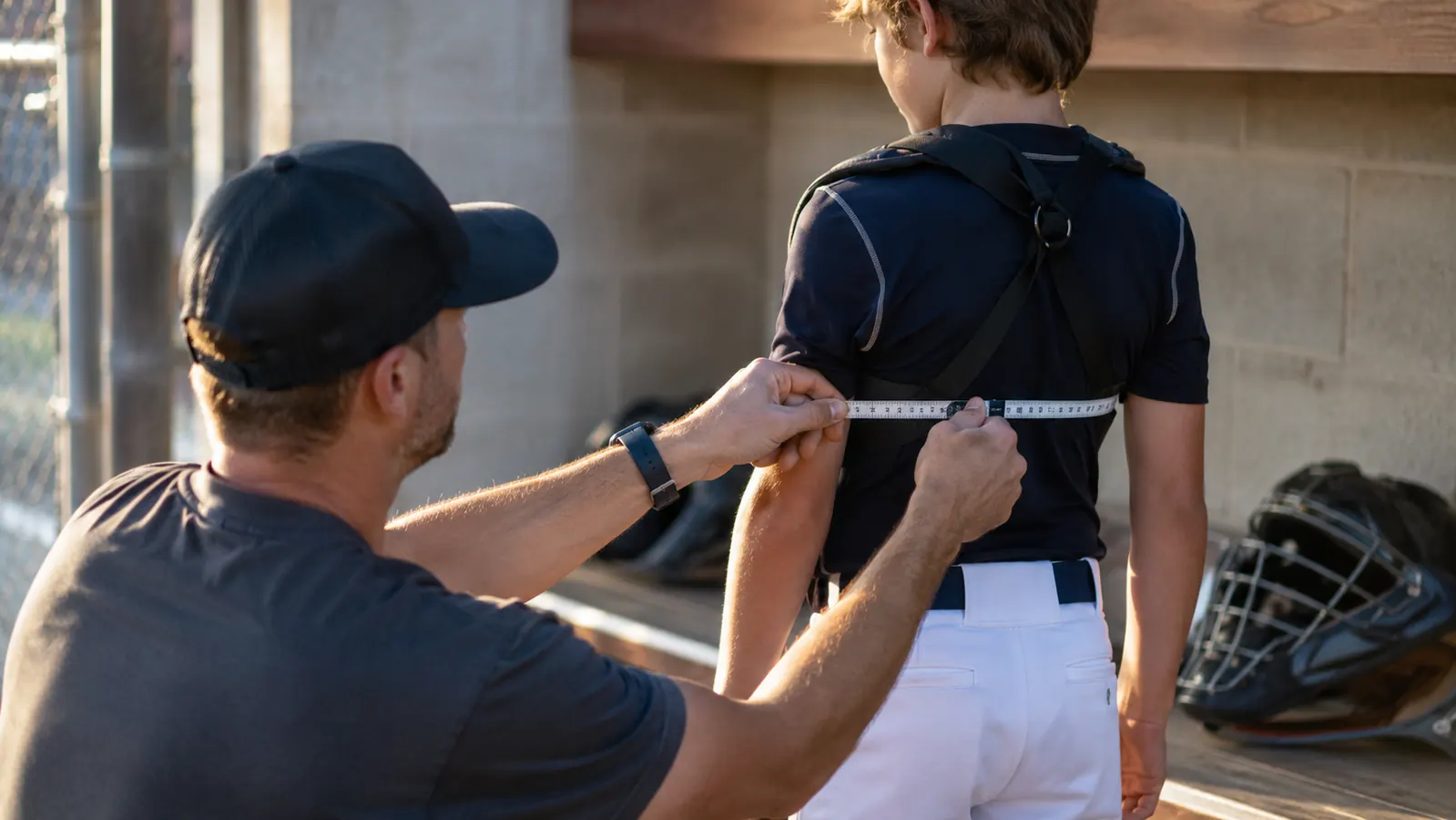
Have the player stand up straight in a t-shirt, no pads. Find the notch at the base of the throat where the collarbones meet, that's your top point. Run the tape straight down the center of the chest to the navel, that's your bottom point. Write down that number in inches. A 9-year-old catcher around 4'6" typically measures somewhere in the 10 to 12 inch range. A 13-year-old closer to 5'4" is usually 13 to 15 inches.
Match that number to the chest protector's labeled length, not to the size printed on the box like 'youth' or 'intermediate.' Those labels vary by brand and by year. A protector that's an inch or two too long will ride into the lap when he squats, which is exactly what happened to my daughter. A protector that's too short leaves the lower ribs and stomach exposed when he's fully down in a crouch, not just standing at the plate.
Do this measurement with him in his actual catching stance if you can, not standing. The torso shortens visually when a kid crouches, and a protector that looked borderline standing up can suddenly show a gap once he's set behind the plate. While he's in the crouch, also check the shoulder caps and armpit cutouts, he needs to raise both arms to frame a pitch and throw down to second without the pads binding at the shoulder, so a protector that fits the torso length but locks up the arms is still the wrong size for a catcher.

Step 2: Measure Knee to Ankle for the Leg Guards
With the player standing, measure from the center of the kneecap down to the top of the ankle bone. This is the number that tells you leg guard length, and it's the measurement most parents skip because they just grab whatever size matches the chest protector in the same box. Leg guards run on their own sizing curve because leg length and torso length don't grow at the same rate, especially in the 10 to 13 age range when kids get long legs before their chest catches up.
Once the guards are on, check three things while he's in a full crouch: the kneecap should sit inside the rounded knee cap of the guard, not above or below it, the thigh guard should cover down to just above the kneecap with no visible gap of bare leg, and the ankle guard should overlap the top of the cleat without pinching when he flexes forward to block a low pitch. If you see a strip of exposed skin at the knee or ankle when he's set in a crouch, the guards are either too short for his current leg length or strapped too loose.
Also check the rotation strap at the back of the knee, it should let the guard swing forward with the shin when he goes down to block, not stay rigid and pull against the leg. A guard that's the right length but strapped too tight at the knee will still restrict blocking form, which shows up as a catcher who blocks with stiff, straight legs instead of dropping cleanly to the ground.

Step 3: Match the Helmet to Actual Hat Size, Not Age
Wrap a soft tape measure around the head about an inch above the eyebrows and ears, where a hat band would sit. That number in inches (or the equivalent hat size, most helmet size charts list both) is what you order to, full stop. Catcher's helmets, unlike a batting helmet, have almost no forgiving foam range because the mask and back plate have to line up with the ears and jaw for the ear guards to actually sit over the ears.
A helmet that's a size too big will shift when he turns his head to track a foul ball, and the ear guards end up sitting an inch behind where his ears actually are. A helmet that's too small won't seat low enough on the forehead and will ride up under contact. Try the helmet on with the chin strap snug and have him shake his head side to side hard, the helmet shouldn't shift more than a quarter inch in either direction.
Once the helmet fits, check the mask bars in front of his eyes while he's in the crouch he actually uses. Some helmet and mask combinations sit a bar right in a young catcher's direct line of sight to home plate depending on head size, and the only way to catch that is to have him look through it at a real target from real catching distance, not just try it on in the living room mirror.

Step 4: Size the Mitt to the Player's Hand and Age Band
Catcher's mitts are measured in circumference around the pocket, typically listed in inches on the tag. As a rough starting band: 8-and-under players usually land around 30.5 to 31.5 inches, 9 to 12 around 32 to 32.5 inches, 13 and up around 32.5 to 34 inches. These bands shift depending on the individual brand's break-in stiffness, so treat them as a starting point, not a rule.
The bigger sizing question at this age isn't circumference, it's pocket depth. A mitt with a deep, closed pocket is harder for a smaller hand to close around a pitch, which shows up as extra passed balls on anything low. If your catcher is struggling to frame low strikes cleanly, check whether the pocket is simply too deep for the size of his hand before you assume it's a receiving problem.
A stiffer, less broken-in mitt at the right circumference will usually serve a smaller hand better than a bigger, more broken-in mitt that's hard for him to close. If two mitts are close in size, hand him both closed and see which one he can snap shut one-handed on a soft-toss pitch, that quick test tells you more than the number on the tag.
Step 5: Recheck Every 8 to 10 Weeks During a Growth Spurt Season
Kids in the 9 to 14 range can gain half an inch to a full inch in height over a single travel season. Set a calendar reminder every 8 to 10 weeks to redo the sternum-to-navel and knee-to-ankle measurements, not just glance at the gear. The gap that shows up first is almost always at the hip line on the chest protector or at the ankle on the leg guards, since those are the two spots where growth in either direction changes the fit fastest.
When the numbers move up a size band, size up the gear that's changed, not the whole set at once. A chest protector that's a full band too short is a real coverage gap and needs replacing. A helmet that's still snug with a quarter inch of headroom is fine for another few months. Resell or hand down whatever a sibling or teammate can actually use, gear that fit correctly six months ago at a smaller size is still good gear, it's just not his size anymore.
Adjustable straps buy you a small window, maybe half an inch at the hip and ankle, but they can't fix a piece that's the wrong length. Don't let a set of stretchy straps talk you into buying a size up now on the idea that he'll fill it out later, an oversized chest protector or leg guard leaves the exact gaps described above the whole time he's growing into it, not just for a week or two. If you're stuck between two adjacent size bands and can't decide, size to the measurement he has today and plan on the recheck in Step 5 rather than rounding up now on a guess.
What Else Helps
Try the full set on over whatever he actually wears underneath during a real game, compression shirt and sliding shorts, not a bare torso in the living room. A chest protector that fits over a t-shirt can sit differently over a padded compression layer in July. It also helps to try gear on in the actual crouch position rather than standing, since that's the position it has to protect in. And if two brands both claim to fit the same age range, trust your own tape measure numbers over the box label every time, sizing charts vary more between brands than most parents expect.
If you're ordering online rather than trying gear on in a store, check the return window before you buy, most retailers give you 30 days, which is enough time to have him wear the full set through two or three practices and confirm nothing shifts or gaps under real movement. It's also worth asking around the team, another parent whose kid grew out of a set last season is often a faster, cheaper first stop than a brand-new purchase, as long as the measurements above still line up. A couple of dollars spent on a cheap fabric tape measure from a sewing kit pays for itself the first time it saves you a return shipping label on a set that looked right in the product photos but didn't match his actual numbers.
Gear that's too big doesn't cover more of the body. It just moves around more when it actually needs to stay put.
Get his numbers, then get the set that matches them.
The Rawlings Velo 2.0 Catcher's Set comes in clearly labeled chest protector, leg guard, and helmet size bands, so once you've got his measurements, matching him to the right set takes five minutes.
Amazon Check Today's Price on Amazon →